

Parker County · Texas
History of Clark Cemetery
Clark Cemetery has been in continuous existence for over 160 years, serving as the private burial ground for family descendants of some of the earliest pioneer settlers of Parker County.
Our Heritage
A Historic Texas Cemetery in Parker County
Clark Cemetery has been in continuous existence for over 160 years serving as the private burial ground for family descendants of some of the earliest pioneer settlers of Parker County. It has a rich heritage that is indelibly linked to the development of this part of Texas and with the families who came here bringing their tenacity and bravery to tame what was then a harsh, dangerous part of Texas.
Clark Cemetery's history is closely linked with the settlement of eastern Parker County. Oral and partially written history from many reliable family sources was carried down to the grandparents of Wayne Clark, Ronnie Clark, Duard Ruland, and Melvin Woody, to mention just a few. That history tells of the grounds now known as Clark Cemetery being a common burial ground for pioneers — used by those passing through in covered wagons and settlers at a time after Texas became a Republic.
Sixty-five unknown graves have been located at Clark Cemetery using 21st century ground penetrating radar technology. Many of the oldest ones had only non-engraved native stones to mark the burial site. Some of the older marked headstones are no longer legible.
The Earliest Graves
An Early Settler Burial Ground
Many early settlers came through the area in wagon trains and camped on the Clear Fork of the Trinity River. One such group was struck by illness and buried their dead at the grounds now called Clark Cemetery near where they camped. The headstones — marked and unmarked — bear testimony to the long history of Clark Cemetery.
Oldest Readable Headstone · 1859
Anzaline Barker Godfrey
The oldest known headstone that is still readable at Clark Cemetery is that of Anzaline Barker Godfrey — the first wife of John W. Godfrey and a daughter of Joseph Barker and Margaret Hopper. She was born in Lafayette County, Missouri on January 10, 1831 and died in Parker County, Texas on February 4, 1859.
Other early settlers include Daniel Kutch (born December 4, 1807 – died June 15, 1874), Henry Ward (born 1828 – died 1897), and Thomas C. Clark (born January 12, 1868 – died January 23, 1894). Several of the families connected with Clark Cemetery are related either directly or through marriage to these earliest settlers.
Est. 1854
Godfrey's Chapel Methodist Church
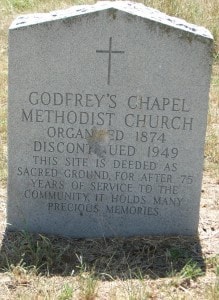
Godfrey's Chapel Methodist Church had its beginning west of Springtown, Texas. In 1854, John Godfrey joined with a group of Christian believers in establishing public services — at a time when Indians were still openly raiding white settlements. The little Methodist Church at Goshen was the first established in the territory now known as Parker County.
John Godfrey wanted a church nearer to his home and in 1874 obtained three acres of land from James Edward and Eliza Ann (Dobbs) Clark. The deed read: "for use as a church, parsonage, school or burial ground." A portion of this plot was part of the grounds that later became known as Clark Cemetery, although it had been a community cemetery without a name for at least a decade before that time.
In 1883, W. M. Dobbs and N. A. Dobbs gave 1½ acres nine miles northeast of Weatherford, Texas on the Upper Denton Road where the church moved. The small Godfrey's Chapel building was enlarged almost twice its size. Part of the land where Godfrey's Chapel previously had been located later became known as Clark Cemetery.
The Heart of the Community
The Godfrey Chapel Church was the center of activities in the community. The Church had a revival each year in August under a brush arbor with straw on the ground — lasting 10 days to a full two weeks, with two services each day. People came from miles around. Early families in the church were Godfrey, Dobbs, Kutch, Ward, Barker, Hayes, Lafferty, Coker, McAnally, Sharpe, Burns, Murphy, Howell, and Cumming.
Today there is a stone marker that marks the spot where the Godfrey's Chapel building stood. After more than 140 years, remnants of the original Godfrey's Chapel building serve as a barn on a ranch less than 2 miles from the original location.
c. 1880 – Present
Clark Cemetery Association Formed
Around 1880, Mr. Clark donated land on the North and Mr. Ward donated land on the South as a permanent cemetery — no legal arrangement — just a gentleman's agreement. In about 1945, the Clark Cemetery Association was formally organized, electing a group of trustees to collect funds and care for the cemetery. The first trustees were W. H. "Buddy" Clark, Troy Clark, Jim Ruland, and Fred Sharpe.
In 1953, the Clark Cemetery Association trustees obtained a deed from the land owners for the cemetery grounds property. Descendants Will Clark, son of Jim Clark, and his wife deeded the land owned by the Clarks. Charlie Ruland and his wife deeded the land that previously had been owned by the Wards. Five years later, the trustees purchased an acre adjoining the property on the West, making the grounds slightly over three contiguous acres.
The original Clark Cemetery Association trustees established a formal endowment fund in the late 1940s that continues right up to today. At present, the Association continues to provide for the maintenance of the grounds with current Trustees Wayne Clark, Ronnie Clark, Sam Cotter, Dave Cumming, Kimberly (Woody) Boretsky, Kenny and Duard Ruland, and Melvin and Sheila Woody.
Since an Ad Hoc Committee was formed in 2010, the Association has made many improvements: installation of a Map Kiosk, a Prayer Garden with bench and altar, a flag pole and flags, and remodeled Pavilion and restrooms with concrete pad and stonework. The Association also obtained a 501(c)(13) designation with the IRS as a non-profit cemetery organization.
1949
Dedication of the Main Entrance
In 1949, a 10-year-old Sharon Ann Cumming (now Hobart) cut the ribbon on a new entrance to Clark Cemetery. A high arch with a sign and two stone pillars greeted those entering. Mrs. S. E. Jessie Margaret (McAnally) Cumming had headed a beautification committee for Clark Cemetery and commissioned rock work on the entrance gate — including memorial stone engravings in honor of her sons, Herbert Winfield and Robert Bruce Cumming, who gave their lives during World War II.
Today, the Texas Historic Cemetery Marker greets those entering through the stone and metal arch main entrance to Clark Cemetery. Flags wave over the Cemetery in homage to the war veterans interred in its grounds as well as the pioneers and settlers who are the ancestors of the families who continue to come to Clark Cemetery.
The historic cemetery marker shall forever remind present day and future ancestors of the tenacious fortitude of the first settlers who braved great hardship to forge a community.
Texas Historic Cemetery Marker · Clark Cemetery · 2013
Remembered
Notable Figures
A few of the many lives remembered at Clark Cemetery.
Anzaline Barker Godfrey
1831 – 1859
Oldest Readable Headstone
First wife of John W. Godfrey and daughter of Joseph Barker and Margaret Hopper. Born in Lafayette County, Missouri; died in Parker County, Texas on February 4, 1859. Her headstone, dated 1859, is the oldest still-readable marker at Clark Cemetery.
Rev. John W. Godfrey
1825 – 1897
Methodist Minister & Community Founder
Born in Knox County, Tennessee. Established Godfrey's Chapel Methodist Church — one of the earliest churches in Parker County — on land that would become Clark Cemetery. A central figure in the settlement of northeastern Parker County.
Jessie Margaret (McAnally) Cumming
Early 20th Century
Cemetery Trustee & Benefactor
Headed the beautification committee for Clark Cemetery and commissioned the stone entrance gate dedicated in 1949 — including memorial engravings honoring her sons Herbert and Robert Cumming, who gave their lives in World War II.
October 12, 2013
The Historic Marker Dedication
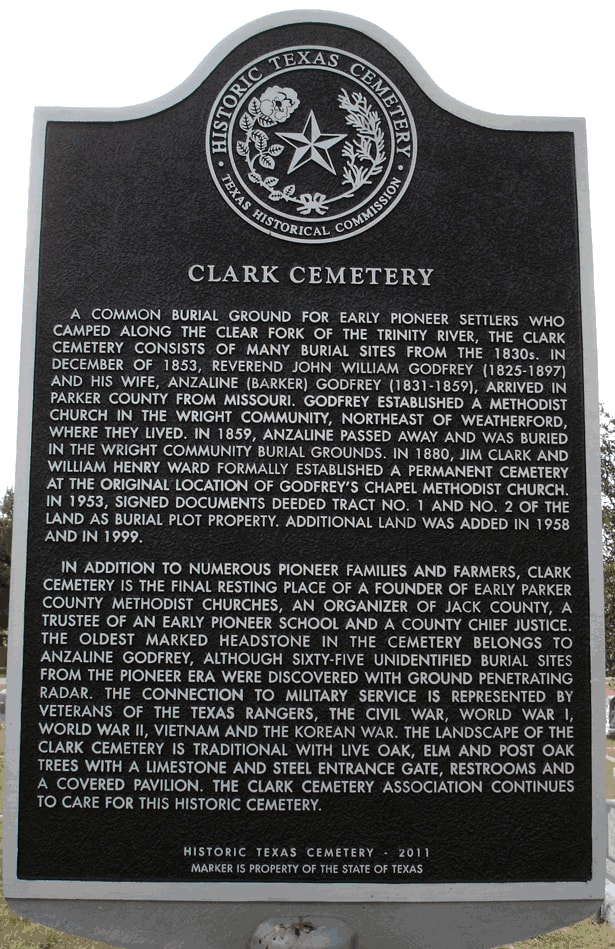
On a beautiful fall afternoon, the 12th day of October 2013, an Official Texas Historic Cemetery Marker Dedication Ceremony was held at Clark Cemetery. The historic marker was formally dedicated by the Texas Historical Commission and the Clark Cemetery Association.
Chronicled on the large cast aluminum historic marker are the nearly two centuries of Clark Cemetery interment history — spanning the 19th and 20th centuries, and, now, into the 21st century. Beginning with the pioneer settlers in the early 1800s to the establishment of Godfrey's Chapel Methodist Church on the original grounds, and highlighted by the grave sites of former members of the various military services, Clark Cemetery today stands as a unique landmark in the history of Parker County.
Ceremony Participants
Jean (McAnally) Morris
Community Elder
Great-grandniece of the pastor of Godfrey's Chapel Methodist Church. Her family has been in the area since the 1850s. At age 92, she unveiled the marker and recalled attending church services by covered wagon as a child. She said she was very proud of the cemetery, its marker, and everything they stood for.
Judge Mark Riley
Parker County Judge
Presented a proclamation honoring the day. Said: "It's important for all of us to share the heritage of the county and the towns in the county to everyone, especially our children and grandchildren."
Kimberly (Woody) Boretsky
Clark Cemetery Association Trustee
Read the text of the Clark Cemetery Historic Marker. Prepared the history and worked closely with the Texas Historical Commission and Parker County Historical Commission Chairman Harold Lawrence.
Sam Cotter
Clark Cemetery Association Trustee
Closed the dedication ceremony with the singing of a hymn and a prayer of remembrance for all those who are a part of the community and Clark Cemetery heritage.
The Clark Cemetery Historical Marker stands prominently behind and between the arched steel and stone columned entrance — a permanent testament to the tenacious fortitude of the first settlers who braved great hardship to forge a community.
Today & Tomorrow
Carrying Down the Traditions of Ancestors
Today, the descendants of the settlers of this part of Parker County, Texas carry down the tradition that is Clark Cemetery and seek to complete the stipulation of the original Clark deed — to perpetually care for the grounds, its heritage, and the heritage of the families connected to it through their tenacious ancestors.
Companion History Site
Our companion site, www.clarkcemeteryhistory.org, is a continuing work in progress to provide historical references for the people and the community surrounding Clark Cemetery — including veterans of wars throughout its history, community leaders, and just plain folks.
www.clarkcemeteryhistory.org →Help us carry on the tradition of our forbears by supporting Clark Cemetery through your family connections, attendance at the Clark Cemetery Association Annual Meetings, volunteering to maintain and improve the grounds, and donating to maintain its small endowment fund.
"We want to protect and preserve the heritage and the Cemetery of these people."
Get Involved